


2. THEORICAL FOUNDATIONS
2.3 Drying time
The drying time of wet solid is determined by the integration between initial and final humidity of the drying rate equation. Made this integration:

To solve this equation, we know that the drying rate W is a function of moisture (X) and generally distinguish two periods:
a) Critical period ahead: It is the period in which the moisture of the solid decreases linearly with the drying time or that is, that during this period the drying rate is constant. The moisture of the solid decreases linearly until a critical moisture value (Xc). Integrating from the initial moisture in the critical moisture leads to the following equation:
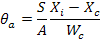
Where:
 = drying time critical period ahead
S = weight of dry solid
A = surface area exposed
 = initial moisture
 =critical moisture
 = critical drying rate
If the final humidity  is greater than the critical moisture, should be replaced
  by the latter equation.
b) Critical period post: It is the period in which the drying rate drops to zero. Start with the critical moisture until it reaches the final moisture or equilibrium moisture.
There are two methods to solve this last period:
- Graphic methods:
If you do not know the analytical relationship W = f (x), integration of the equation must be graphically represented by X in front of 1 / W. The value of the integral is the area bounded by the curve, the axis of abscissa and the ordinates and extreme
- Analytic methods: If the drying rate varies linearly with moisture from the moisture critical to the final integration of the equation leads to the expression:
Where:
= drying time critical period post
S = weight of dry solid
A = surface area exposed
= final moisture
= final drying rate
= logarithmic drying rate
If you do not know how that changes the drying rate during this period, you can get an approximate expression assuming a linear variation from the critical moisture to equilibrium. Accepting this hypothesis comes to the following expression:
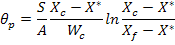
Where:
S = weight of dry solid
A = surface area exposed
= moisture balance
In these last two equations assume that the initial humidity is greater than the critical; otherwise, be replaced
by
.
